Direct Flights Between Pune (PNQ) and Bagdogra (IXB)

20 January 2026, by Sachin Thapa (Petition Starter)

To the Respected Decision-Makers at the Ministry of Civil Aviation, Airport Authority of India, and Airline Operators,

We, the undersigned citizens, frequent travellers, professionals, students, defence personnel, and tourism stakeholders, respectfully request the introduction of direct commercial flights between Pune (PNQ) and Bagdogra (IXB).

Despite strong economic, educational, defence, and tourism linkages between these two regions, there is currently no direct air connectivity, forcing passengers to rely on time-consuming and costly one-stop routes via Delhi, Kolkata, Banglore, Hyderabad or Mumbai.


pune, city, s, night, building, culture, house, india, nature, sky, architecture, modern, street, lights, mumbai, skyline, landscape, travel, outdoor, crowd, people, high, headlights, night sky, rain, water

INTRODUCTION

Start Direct Flights Between Pune (PNQ) and Bagdogra (IXB)

Movement of people from north-east India to the popular and more developed cities of southern, western and northern India has seen a marked increase after the liberalisation of the Indian economy which resulted in a boom of the private and service sector.(Remesh, 2012, McDuie-Ra, 2012). Before liberalisation of the Indian economy,

Before liberalisation of the Indian economy, migration of people from the North-East† to the metro cities were few and mostly education-related or related to Government services boosted by the implementation of reservation polities (Angelove, 2015). 

As MNCs and international brands proliferated in the Indian economy, specifically in the major cities like Delhi, Mumbai, Bangalore, Kolkata and Pune, a large and comprehensive market for skilled and semi-skilled labour was created. Therefore the shift from an agriculture and production based economy to a service based economy resulted in a new form of migration that was different from the earlier education based migration of the elite or migration of highly educated-skilled workers at the higher ends and the migration of poor, uneducated and unskilled labourers, mostly to work in factories, mines, plantations, construction sites, etc. in the bottom ends; now, to a large group of migrants who are moderately or lowly educated contributing to semi-skilled labour of the service economy. Women, mostly young and unmarried, constitute a significant portion of this group of migrants (Mukherjee and Dutta, 2017; Marchang, 2017). 

The present paper attempts to understand experiences of migrants from the North-East, working in the service industry, like hospitality and retail, in terms of its influence on the workers’ subjectivities and aspirations. The research is qualitative and exploratory in nature

PNQ - IXB The key values

Based on the sources, a mandatory direct flight between Bagdogra and Pune would address critical socio-economic and educational needs by connecting the primary gateway of North-East India with one of its most important mainland destinations.

The following reasons support the necessity of this direct connection:

1. High Demand from Migrant Workers

Pune is identified as one of the main destinations for Nepali migrant workers in India, who are increasingly employed in hotels, restaurants, and the manufacturing sector. Additionally, the boom in the private and service sectors after liberalization has created a large market in Pune for skilled and semi-skilled labor from North-East India, particularly in hospitality and retail. A direct flight would facilitate the “circulatory migration” (the back-and-forth movement) that characterizes these workers’ journeys between their hometowns and their places of employment.

2. Connection to an Educational Hub

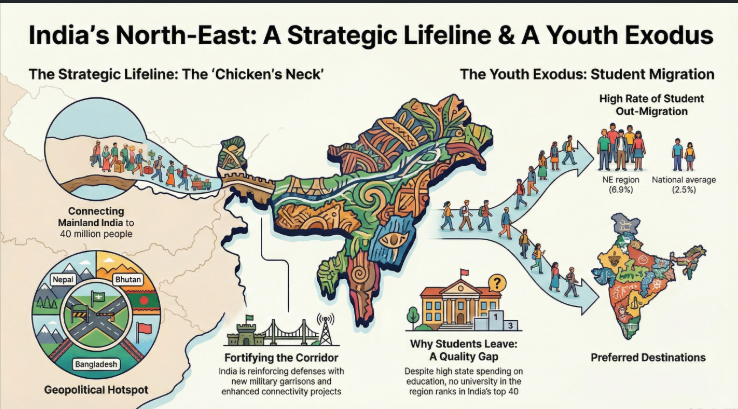
Maharashtra is a premier destination for students from the North-East, accounting for 10.1% of all student migrants from that region in the 2011 Census. Pune, specifically, is recognized as home to institutions of “national education excellence” such as IISER Pune, which serve as symbols of academic elitism and attract students seeking better opportunities than those available in the North-East. Currently, students must navigate complex “step-migration” or fragmented travel routes to reach these hubs.

3. Logistical Importance of Bagdogra

Bagdogra is described as the only airport of national interest in the Siliguri Corridor, also known as the “Chicken’s Neck”. This corridor is the sole terrestrial connection between mainland India and the eight northeastern states, serving as a lifeline for over 40 million people. Establishing a mandatory direct link to Pune would bridge the gap between this strategic regional gateway and the western mainland.

4. Mitigation of Connectivity Blows

Pune’s air connectivity has recently suffered significant setbacks, such as the suspension of its direct flight to Singapore, which was described as a “huge blow” to the city’s international and domestic mobility. Simultaneously, other major airlines have suspended critical regional routes, such as the Mumbai-Bagdogra flight. A direct Bagdogra-Pune route would provide much-needed operational stability and restore essential connectivity for both industrial and personal travel.

5. Addressing Infrastructure and Safety

While Pune airport currently faces capacity constraints and delayed infrastructure projects, such as the construction of new parking bays, a direct flight would streamline movements for a population that is otherwise forced to rely on congested transit points like Mumbai. Furthermore, providing direct air access for North-East migrants can help reduce their reliance on public transit in regions where they have historically reported experiencing sporadic racial violence and discrimination.


Advantage for Airlines Operating

Based on the sources, an airline establishing a direct route between Bagdogra and Pune stands to gain several strategic and commercial advantages by tapping into high-volume, consistent travel demographics and filling gaps left by recent service reductions.

The primary advantages include:

1. Capturing High-Volume Student Traffic

Pune is a major destination for students from North-East India, who seek the quality of education and “national education excellence” found in premier mainland institutions.

  • Market Share: Maharashtra is one of the top destination states for students from the North-East, accounting for 10.1% of all student migrants from that region in the 2011 Census.
  • Academic Hubs: Pune is home to institutions of national importance, such as IISER Pune, which attract students who view these degrees as symbols of “educational elitism” necessary for their career trajectories.

2. Tapping into Circulatory Migrant Labor

The route connects a primary labor source with a key industrial destination. Pune is identified as one of the main destinations for Nepali migrant workers in India.

  • Frequent Travel: The nature of this migration is described as “circulatory” (aaune-jaane), meaning workers frequently travel back and forth between their villages in the hills and their places of work in Pune.
  • Service Sector Demand: Pune’s boom in the private and service sectors has created a vast market for skilled and semi-skilled labor from the North-East in hospitality and retail. These workers are often preferred by employers for their “smiling faces, politeness, and good looks”.

3. Exploiting a “Logistical Lifeline” with Limited Competition

Bagdogra serves as the only airport of national interest in the Siliguri Corridor, which is the sole terrestrial link between mainland India and the eight northeastern states.

  • Strategic Gateway: This corridor serves a population of over 40 million people, providing a massive catchment area for an airline.
  • Service Gaps: Major carriers have recently suspended critical related routes, such as the Mumbai-Bagdogra flight and Pune’s direct international connection to Singapore. An airline serving Bagdogra-Pune directly would capture passengers who otherwise have to navigate “step-migration” or fragmented transit through congested hubs like Mumbai.

4. Strong Industrial and Corporate Backing

Pune’s industrial leaders have expressed significant concern over the city’s “very limited” air connectivity, describing recent flight cancellations as a “huge blow” to the city’s mobility. An airline providing a direct link to a strategic regional gateway like Bagdogra would likely benefit from strong local business demand and corporate travel, particularly given Pune’s high concentration of MNCs and international brands.

5. Social and Safety-Driven Demand

North-Eastern migrants have historically faced sporadic racial violence and discrimination in mainland public spaces and transit routes. A direct flight offers a safer, more “sophisticated and safe space” for travel compared to multi-modal transit through regions where these migrants report feeling “isolated” or “unfairly treated”. This preference for a “safe environment” can drive a loyal customer base among the migrant community.

Based on the sources provided, here is a data-driven info of the travel demand, strategic importance, and infrastructure factors supporting a direct flight route between Bagdogra and Pune.


✈️ Connectivity Hub: The Bagdogra-Pune Direct Route

Connecting India’s “Chicken’s Neck” to the Western Industrial Core


1. THE HUMAN FLOW: WHY THEY TRAVEL

High-volume migration driven by education and the “New Service Economy.”

  • 🎓 Student Migration (The “Aspirants”):
    • 10.1% of all student migrants from North-East India choose Maharashtra as their destination.
    • Pune is a magnet for “educational elitism,” housing institutions of national excellence like IISER Pune.
    • There is a visible trend of students moving away from northern hubs like Delhi (which saw a 4.2% drop in NE student intake) toward safer, more cosmopolitan western/southern cities.
  • 💼 Labor Migration (The “Veins of the Economy”):
    • Pune is officially identified as a “main destination” for Nepali and North-Eastern migrant workers.
    • The nature of this travel is “circulatory” (aaune-jaane), meaning workers frequently travel back and forth between their villages and Pune’s industrial/hospitality sectors.
    • Migrants are highly sought after by Pune’s MNCs and international brands for “aesthetic labor,” particularly in malls and high-end restaurants.

2. STRATEGIC GATEWAYS: THE TWO ENDPOINTS

Linking a critical national lifeline to a constrained western hub.

  • 📍 Bagdogra (The Gateway):
    • Located in the Siliguri Corridor (“Chicken’s Neck”), the sole terrestrial link to 8 states.
    • It is the only airport of national interest in this corridor, serving a regional population of over 40 million people.
  • 📍 Pune (The Hub):
    • A primary center for India’s “new service economy” following economic liberalization.
    • Currently serves as a transfer point for students and workers who otherwise navigate complex “step-migration” (traveling through multiple cities to reach their final destination).

3. THE INFRASTRUCTURE GAP: SUPPLY VS. DEMAND

Current capacity is shrinking while demand remains high.

Metric Data Point
Total Daily Movements (Pune) Currently 194–198 (Down from a peak of 200+)
Parking Infrastructure Only 10 bays currently available at Pune Airport
Capacity Constraints Recent “operational meltdowns” at Pune forced flight diversions due to occupied bays
Service Blows Recent suspension of Mumbai-Bagdogra (daily) and Pune-Singapore routes

4. MARKET OPPORTUNITY FOR AIRLINES

Why this route is a “Blue Ocean” opportunity.

  • Safety & Sophistication: Migrants view airports and malls as “sophisticated and safe spaces” to avoid the racial discrimination and violence often encountered in multi-modal ground transit.
  • Captive Audience: With the suspension of the Mumbai-Bagdogra flight, a significant transit link for travelers from the west to the North-East has been severed.
  • Untapped Potential: While billions are being invested in highway corridors (like the ₹35,000 crore Shamli–Gorakhpur Expressway), air travel remains the fastest way to bridge the 2,000+ km gap between these two regions.

5. THE “CIRCULATORY” TRAVEL TREND

  • Youth-Centric: Over 90% of these migrants fall in the 15–29 age group.
  • Employment-Driven: Migrants often start at a young age and continue the back-and-forth travel cycle until they are old.
  • Language Capital: Migrants in Pune/Delhi who speak Hindi/English have higher career aspirations and travel more frequently for professional growth.

Academic and Research Reference Links

Institutional and Government Links

Archived and External News Links

Wikipedia Reference Permalink IDs

Relevant DOIs (Digital Object Identifiers)

Petition

Petition: Request to Start Direct Flights Between Pune (PNQ) and Bagdogra (IXB)

Show Your Support | Sign the Petition